
FDA Tightens EO Validation Filing Requirements




On June 29, 2026, the FDA updated its Sterilization Validation Guidance for 510(k) and De Novo Submissions, introducing a more explicit submission requirement for Class II and higher devices sterilized with ethylene oxide (EO). From October 1, 2026, filings must include a full validation package covering sterilization parameters, load distribution maps, full batch serial traceability for biological indicators (BI), and third-party laboratory comparison data. This is worth close industry attention because it affects not only product submission materials, but also export readiness, supplier documentation quality, and importer review practices for Industrial EO Sterilizers serving the U.S. market.
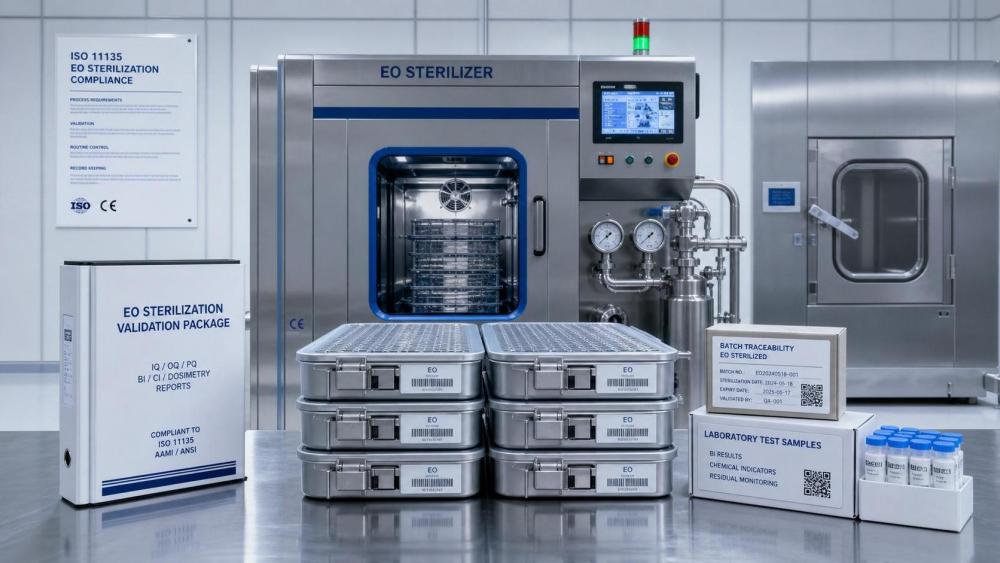
What the updated FDA guidance now requires
The confirmed facts are limited but clear. The FDA updated the guidance on June 29, 2026. The updated guidance applies to all Class II and above devices that use EO sterilization. Starting October 1, 2026, submissions must include a complete validation package. According to the provided summary, that package must contain sterilization parameters, load distribution maps, full batch serial numbers for biological indicators, and third-party laboratory comparison data.
The same summary also states that the change directly affects the compliance path for Industrial EO Sterilizers suppliers exporting to the United States, and that importers need to reassess whether current supplier validation files are complete enough under the updated requirement.
Where the pressure is likely to appear first
Export documentation may become a gating item
From an industry perspective, exporters connected to EO-sterilized Class II and higher devices may face immediate pressure at the submission-document level. The core issue is not only whether sterilization was performed, but whether the supporting validation record is complete in the format now expected. What deserves closer attention is the traceability depth now tied to BI batch serial numbers and the inclusion of third-party comparison data, because both can expose gaps in legacy files that were previously treated as sufficient.
Importers will need to look harder at supplier files
Importers are directly referenced in the event summary, which suggests that supplier qualification and file review may become a more practical control point. Analysis shows that import-side teams may need to recheck whether existing validation packages contain all required elements before relying on them in U.S.-bound business. The impact is likely to fall on onboarding, file acceptance, and transaction readiness rather than on pricing or volume assumptions, which are not provided in the input.
EO sterilization equipment suppliers may face added compliance scrutiny
For Industrial EO Sterilizers suppliers, the change matters because export compliance may now depend more visibly on how validation evidence is assembled, retained, and presented. Observably, the issue is not limited to technical performance claims. It also reaches documentation discipline, data traceability, and alignment with third-party testing records where those records form part of the submission package.
Testing and validation support functions may become more operationally important
Where companies rely on external validation or laboratory support, the requirement for third-party laboratory comparison data may affect document collection workflows and review timing. This should be understood as an operational implication rather than a confirmed market outcome. The main point is that documentation dependencies across manufacturers, sterilization partners, and testing support providers may become more visible under the updated filing expectation.
Practical points companies should check now
Review whether current validation files are complete at record level
Analysis shows that companies should not limit their review to a high-level confirmation that EO validation exists. A more useful check is whether files already contain the specific elements named in the summary: sterilization parameters, load distribution maps, BI full batch serial traceability, and third-party laboratory comparison data.
Reassess supplier document readiness before new submissions
For importers and procurement teams, what deserves closer attention is whether incumbent suppliers can provide documentation in a form that supports post-October 1, 2026 submissions. If documentation gaps exist, they may affect submission timing, supplier continuity, or document remediation work, even where the underlying commercial relationship remains unchanged.
Watch filing, quality, and procurement teams together
This update touches multiple internal functions at once. Regulatory teams will care about submission content, quality teams about traceability and record integrity, and procurement teams about supplier qualification evidence. It is more appropriate to understand this as a cross-functional compliance issue rather than a narrow technical update limited to sterilization specialists.
Continue tracking execution details that are not yet provided here
The input does not provide further detail on enforcement practice, review interpretation, or how uniformly the requirement will be applied across product situations. For that reason, companies should treat the current information as a confirmed rule change with open execution questions still worth monitoring.
How this change should be read at this stage
Observably, this is more than a general policy signal. The update includes a stated effective date and names concrete submission elements, which gives it the character of an implementation-oriented compliance requirement. At the same time, analysis shows that the operational burden will depend on how firms currently structure EO validation records and how review expectations are applied in practice. That is why the industry still needs to watch subsequent interpretations, filing behavior, and market feedback rather than assuming a single uniform impact.
Why this matters beyond the wording of the guidance
The practical significance of this event lies in the shift from broad validation sufficiency toward more explicit documentation completeness and traceability expectations. For companies involved in EO-sterilized Class II and higher devices, the immediate question is less about whether the rule exists and more about whether current files, suppliers, and review processes are ready for the October 1, 2026 threshold. It is more appropriate to understand this development as a concrete compliance signal that has already been defined at a rule level, while its full execution impact still requires continued observation.
Basis of this article and what still needs verification
This article is based on the user-provided news title, event date, and event summary. For events of this type, relevant source categories usually include official regulatory announcements, regulator-issued guidance updates, trade or customs authority information, industry association releases, standards body documents, and reporting by established professional media. A specific official source link was not provided in the input, so the exact official publication path still needs to be verified on an ongoing basis.
Further observation is still needed on detailed implementation language, certification and submission interpretation, procurement document updates, tender-file changes, industry feedback, and how companies actually adapt their validation and traceability workflows after the stated effective date.
Related News
 Industrial EO SterilizersEO Sterilization Equipment Price: What Drives Cost in Medical and Industrial Use?EO sterilization equipment price varies by cycle speed, safety systems, compliance support, and total ownership cost. Discover what really drives value in medical and industrial use.Aug 14, 2026Author:Sterilization Dynamics Strategist
 Industrial EO SterilizersHow to Evaluate Ultrafiltration Membranes in Japan for Stable Water Treatment PerformanceUltrafiltration membranes Japan evaluation guide: compare flux stability, fouling resistance, cleaning recovery, and supplier quality to choose reliable water treatment performance.Aug 13, 2026Author:Sterilization Dynamics Strategist
 Industrial EO SterilizersHow to Evaluate Hollow Fiber Ultrafiltration Membranes for Water Treatment SystemsUltrafiltration membranes hollow fiber evaluation starts with real water treatment demands. Learn how to compare flux stability, fouling resistance, integrity, and lifecycle cost.Jul 23, 2026Author:Sterilization Dynamics Strategist
Related News
- 00
0000-00
EU MDR Clinical Evaluation Requirements: Evidence, CER Updates, and Compliance Gaps - 00
0000-00
Electrosurgical Safety Monitoring: How OR Teams Detect Return-Electrode Risks - 00
0000-00
How to Evaluate Surgical Stapler Cartridge Manufacturers for Quality and Supply Reliability - 00
0000-00
ASTM F1980 Accelerated Aging: Setting Shelf-Life Claims for Sterile Packaging - 00
0000-00
How European Hospitals Can Reduce Consumable Procurement Costs Without Supply Risk
Sterilization Dynamics Strategist
Weekly Insights
Stay ahead with our curated technology reports delivered every Monday.